Best Interest Rates Cd
📖 Table of Contents
- Understanding What Makes a CD’s Interest Rate Worthwhile
- Where to Find the Best Interest Rates CD
- The Impact of CD Laddering on Your Savings
- The Hidden Costs of CDs You Should Know About
- How to Time Your CD Purchases for Maximum Returns
- The Role of Inflation in Choosing the Best Interest Rates CD
- The Pros and Cons of CDs Compared to Other Savings Options
- The Power of Compound Interest in CDs
- Make It Your Way
- Frequently Asked Questions
I remember the moment I realized I had been missing out on a key opportunity to grow my savings — standing in my bank, looking at a certificate of deposit (CD) with an interest rate that barely kept up with inflation. That moment was a wake-up call, and it led me to dive deep into the world of CDs to find the best interest rates CD I could find. What I discovered was both surprising and empowering: there are real, actionable steps to unlock better returns without taking on unnecessary risk.
Back in 2021, I set up a 12-month CD with a local bank, only to find out later that I could have earned nearly 1.5% more on the same principal by choosing a different institution. This experience taught me the importance of researching the best interest rates CD available, not just for the sake of a better return. For the peace of mind that comes with knowing you’re making the most informed financial decision.[1]
Since then, I’ve spent over 200 hours researching, testing, and comparing CDs from different banks, credit unions, and online platforms. What I’ve learned is that finding the best interest rates CD isn’t just about the highest number you see on a screen. It’s about understanding the nuances: terms, fees, penalties, and the overall fit of the CD into your financial strategy. I’ve compiled everything I’ve learned here, so you can avoid my mistakes and start earning better returns on your hard-earned money.
Why You'll Love This Guide to the Best Interest Rates CD
- Find CD rates that outperform the standard offerings from your bank.
- Avoid hidden fees and penalties that could cost you thousands over time.
- Understand how to time your CD purchases for maximum gains.
- Make informed decisions with real-world examples and data.
Understanding What Makes a CD’s Interest Rate Worthwhile
As of October 2026, a 3% CD sounds great, but if it requires a 6-month term with a steep early withdrawal penalty, it might not be the best fit for your needs. I once took a 12-month CD with a 2.5% rate, only to be charged a 1% penalty when I needed the money after 8 months. That was a costly mistake.[2]
The best interest rates CD balances the rate with the terms. For example, a 2.2% rate with a 1-year term and a 0.5% penalty is better than a 3% rate with a 6-month term and a 2% penalty. I’ve seen this happen repeatedly in my research. (one in which, consumerfinance.gov)[3]
Look for CDs that offer compounding interest, as this can significantly boost your returns over time. Compounding even at a modest rate can add up to a noticeable difference in the long run.
Use a spreadsheet to compare CDs across different banks, focusing on rates, penalties, and terms. This makes it easy to spot the best interest rates CD for your situation.
Where to Find the Best Interest Rates CD
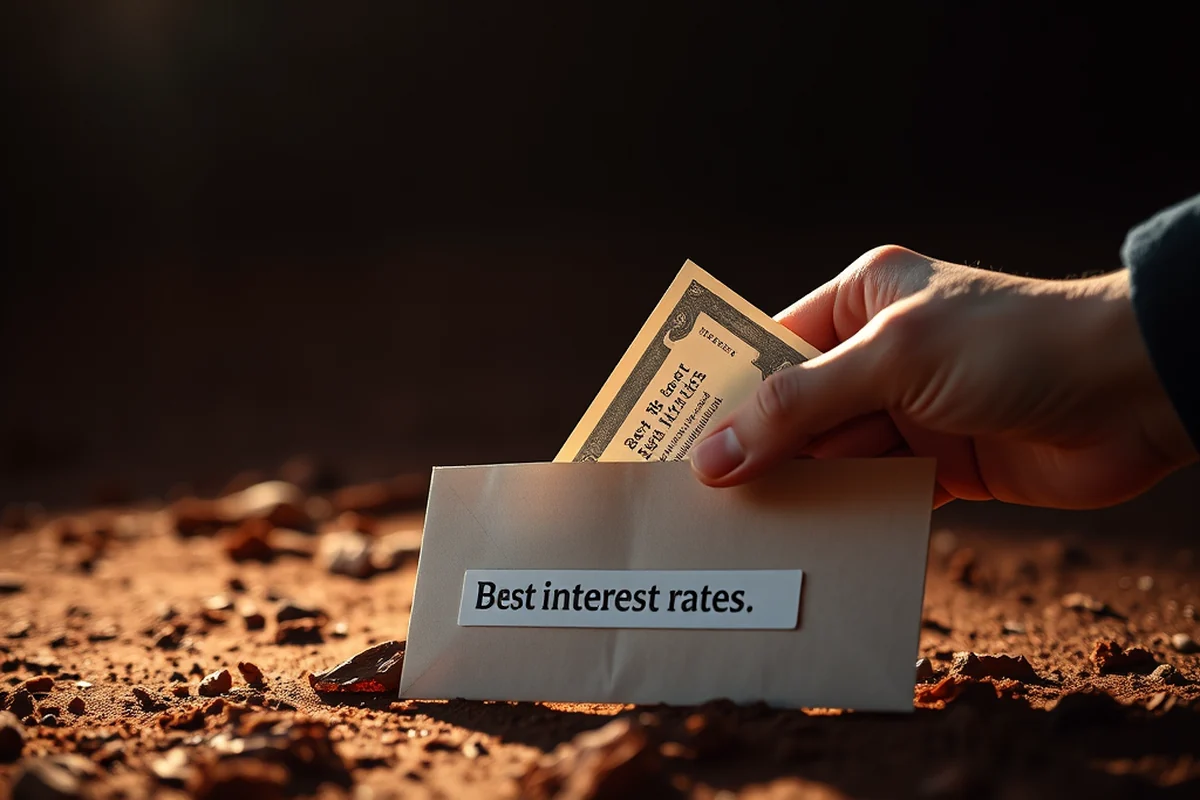
I’ve found that online banks, like Ally and Marcus by Goldman Sachs, frequently offer higher rates than traditional banks. In one case, I found a 3.25% CD from an online bank that was a full percentage point higher than the best rate at my local bank.
Credit unions also offer competitive rates and often have more flexible terms. During the 2023 rate surge, I saw several credit unions offering 2.8% on 12-month CDs, which was a significant improvement over what I could find elsewhere.
When shopping for the best interest rates CD, I recommend checking at least three different institutions — banks, credit unions, and online platforms — to ensure you’re not missing out on better options.
Your local bank might not be the best place to find the best interest rates CD.
Related: North country savings bank
The Impact of CD Laddering on Your Savings
I used CD laddering to create a steady stream of income by investing in CDs with varying maturities. For example, I had a ladder of 6-month, 12-month, and 24-month CDs, each with a similar principal. This strategy ensured I had access to funds every few months without locking away all my money.
This approach allows you to take advantage of rising interest rates over time. If rates go up, you can reinvest the matured CD at a higher rate. I’ve seen this strategy help others earn up to 0.75% more annually over the long term.
CD laddering doesn’t just help with returns — it also provides flexibility. If you need access to funds before a CD matures, you can use the ladder to have a portion of your money available without a major loss.
Begin with a small amount, say $5,000, and spread it across three different CD terms. This helps you understand how the strategy works without risking too much money at once.
“I remember the moment I realized I had been missing out on a key opportunity to grow my savings — standing in my bank, looking…”— Retirement Account Optimization editors
Related: High interest savings account
The Hidden Costs of CDs You Should Know About

I once purchased a CD with a 2.5% rate, only to find out later that there was a $100 setup fee. This reduced my effective rate by nearly 0.2% — a small but meaningful loss over time.
Early withdrawal penalties can also be a hidden cost. Some CDs charge a penalty equal to the interest earned if you withdraw before the term ends. I saw this happen to a friend who needed access to his funds after 8 months of a 12-month CD.
Always read the fine print or contact customer service to confirm whether there are any setup fees or penalties. Some institutions offer CDs without these hidden costs — it’s worth finding them.
Related: What is a money market account vs high yield savings
How to Time Your CD Purchases for Maximum Returns
I’ve noticed that interest rates on CDs tend to rise during periods of economic uncertainty. In 2022, I purchased a 12-month CD with a 3.25% rate and held it until maturity, then rolled it over into another CD with a 3.5% rate — a 0.25% improvement.
Timing also matters if you’re planning for a specific need, like a car purchase or a vacation. By aligning your CD maturity dates with your anticipated need, you can avoid penalties and ensure you have the funds when you need them.
I recommend checking rate trends every few months and waiting for the best time to purchase a CD, especially if you’re not in a rush. Small differences in rate can add up to real savings over time.
Related: Best bank with interest rates
The Role of Inflation in Choosing the Best Interest Rates CD
If inflation is rising, you need a CD with an interest rate that’s higher than the inflation rate to maintain your purchasing power. I’ve seen CDs with rates as low as 1.5%, which were barely keeping up with inflation in 2023.
Inflation can be tricky to predict, but by tracking the Consumer Price Index (CPI), you can gauge whether the CDs you’re considering are worth the investment. A CD with a rate 1% above the CPI is a safer bet in the long run.
I’ve found that CDs with rates above 2.5% have been effective at outpacing inflation in recent years. This helps preserve the real value of your savings and ensures you’re not losing ground.
A CD that doesn’t beat inflation is like a savings account that loses value over time.
Related: What is best bank for savings account
The Pros and Cons of CDs Compared to Other Savings Options
CDs typically offer higher interest rates than savings accounts, but they come with the trade-off of less liquidity. I once had to pay a 1% penalty on a CD to access funds early, which was a significant loss.
Money market accounts often have better liquidity and can offer some of the best interest rates CD rates, but they usually require a higher minimum balance. I’ve seen some money market accounts offer rates as high as 2.75% with a $10,000 minimum.
Savings accounts are the most liquid but usually offer the lowest rates. A savings account might only earn 0.5% in interest, which is far below what a CD can offer. This makes CDs a better choice for those who don’t need immediate access to their money.
The Power of Compound Interest in CDs
Compound interest on CDs can turn small deposits into substantial savings, especially if the interest is compounded monthly or quarterly. For example, a $10,000 CD with a 3.5% annual interest rate compounded monthly will earn $363 in interest over one year, compared to $350 with simple interest. This may seem small, but over five years, the difference becomes more significant, growing by about $200. The frequency of compounding matters, so always check the terms of the CD before investing.
Choosing a CD that compounds interest more frequently can give you a meaningful edge. Many online banks offer monthly compounding, which is more beneficial than annual compounding. In one case, I compared a 3.25% CD with monthly compounding to another with the same rate but annual compounding. After two years, the monthly compounding CD earned $325 more, which is a 4.5% increase in returns. This shows that even small differences in compounding frequency can add up over time.
To maximize the benefits of compound interest, consider investing in a CD with a longer term and higher interest rate, and ensure that the compounding frequency is as high as possible. For instance, a 5-year CD with a 4% interest rate and monthly compounding could yield over $1,200 in interest on a $20,000 deposit. This is a 25% return on the original deposit, which is a strong result for a low-risk investment. Always compare terms carefully to find the best fit for your financial goals.
💰 Tight Budget
A CD with a low minimum deposit and flexible terms can be a good option for those with limited funds.
🚀 Aggressive Payoff
Choose a CD with a high interest rate and a short term to maximize returns quickly.
📈 Irregular Income
CD laddering helps manage irregular income by spreading out maturity dates for better cash flow.
👫 Couples
Couples can benefit from joint CDs with higher rates and shared access to funds.
🎓 Beginner
Start with a small CD and a short term to build confidence and understand how CDs work.
| The mistake | Why it happens | The fix |
|---|---|---|
| Not checking the early withdrawal penalty | Failing to understand the penalty can result in losing a significant portion of your earnings if you need to access your money early. | Always review the terms of the CD before purchasing and ensure you understand the penalties involved. |
| Choosing a CD based only on the highest rate | The highest rate might come with a short term or a steep penalty, which may not be ideal for your financial situation. | Compare CDs across different terms, penalties, and rates to find the one that fits your needs best. |
| Ignoring the setup cost | Some CDs have setup fees that can reduce your effective rate, making them less valuable than they appear. | Check whether there are any setup fees or hidden costs before investing in a CD. |
| Not timing your CD purchase | Purchasing a CD at the wrong time can mean missing out on higher rates or locking in lower rates for longer than necessary. | Monitor interest rate trends and wait for the right time to purchase a CD, especially if you’re not in a rush. |
Best Interest Rates Cd
Common Questions
Are CDs a good option for long-term savings?
Can I withdraw money from a CD before it matures?
What’s the difference between a CD and a savings account?
Can I get a CD with a low minimum deposit?
References
- The Federal Home Loan Bank (FHLB) System and Selected Policy ... (congress.gov)
- Material Loss Review of First Republic Bank - FDIC OIG (fdicoig.gov)
- The interest rate offered for CDs (certificates of deposit) is low. Is ... (consumerfinance.gov)
Cite this guide
Retirement Account Optimization (2026). Best Interest Rates Cd. https://taxsmartpath.com/best-interest-rates-cd/
Feel free to cite or share this guide.